
Deep Plane vs SMAS Facelift: What Actually Differs
Both techniques address the SMAS layer, but they treat it in fundamentally different ways. The distinction explains why one result can look pulled and the other rested.
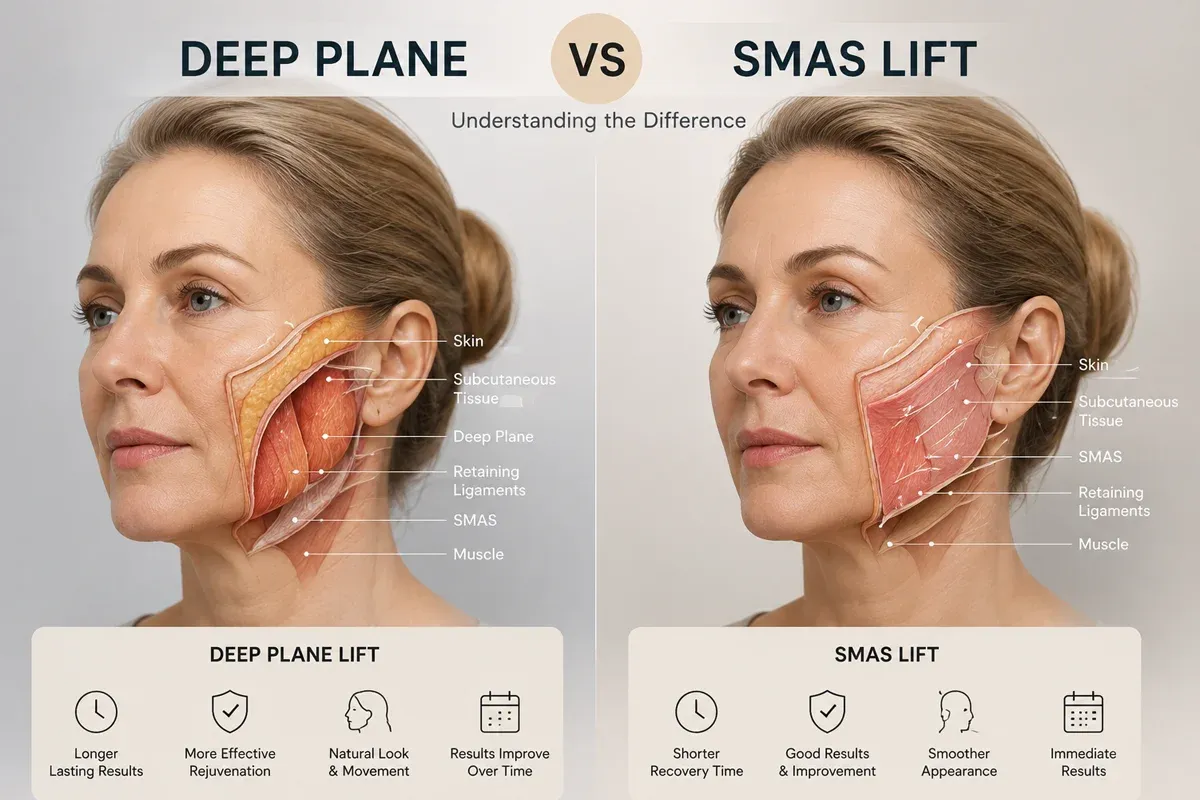
Patients researching facelift surgery encounter “deep plane” and “SMAS” constantly, usually with the implication that one is modern and the other outdated. The reality is more specific: both operate on the same anatomical layer, but they do different things to it, and that difference is visible in the result.
What the SMAS is
The SMAS — superficial musculoaponeurotic system — is a sheet of fibrous and muscular tissue lying between the skin and the deeper structures of the face. It is continuous with the platysma in the neck and connects to the muscles of facial expression.
It matters because it is the layer that actually carries facial shape. Skin sits on top of it and, over time, descends with it.
The conventional SMAS lift
In a traditional SMAS facelift, skin is lifted off the SMAS as a separate layer. The SMAS is then tightened — folded, trimmed or sutured — and the skin is redraped over it and trimmed.
The limitation is structural. The retaining ligaments that anchor the face to bone are not released, so the tissue can only be tightened around those fixed points rather than repositioned. Much of the visible lift ends up being carried by the skin, pulled in a lateral direction.
Two consequences follow. Laterally tensioned skin produces the swept-back look patients recognise as an operated face. And because skin is elastic, it relaxes, so the result relapses sooner.
The deep plane approach
A deep plane facelift enters beneath the SMAS and releases the retaining ligaments directly. Once released, the SMAS and the overlying skin move together as a single composite unit.
That unit is repositioned along a vertical vector — upward, following the direction in which the face descended — and secured by the deep layer. The skin is then redraped and closed without tension.
Three things follow from this:
- Tension sits in tissue built to hold it. The skin is a covering, not a suspension system.
- The vector is vertical rather than lateral. Faces age downward, so lifting upward restores the previous position instead of stretching sideways.
- The midface actually moves. Releasing the ligaments is what allows the cheek to be repositioned over the cheekbone, which a SMAS-only lift cannot achieve.
Which suits which patient
Deep plane technique is directed at established structural change: midface descent, a fold deepening between nose and mouth, jowling across the jawline, and neck laxity.
A conventional SMAS lift remains reasonable for a patient with mild laxity, good skin quality and an intact midface — the operation is shorter and the recovery marginally quicker.
Neither is appropriate for a patient whose principal complaint is a heavy brow and tired eyes with a jawline still intact. That pattern belongs to the upper face, and an endoscopic face lift addresses it directly.
The honest caveat
Technique matters less than judgement. A well-executed SMAS lift on a suitable patient produces a better outcome than a deep plane lift on a poorly selected one. The question worth asking a surgeon is not which technique they use but why they are recommending it for your face.
The deep plane facelift page sets out what the operation involves, the recovery timeline and what to plan for if you are travelling to Antalya.
Frequently Asked Questions
Is a deep plane facelift better than a SMAS facelift?
It is better suited to established midface descent and jowling, because it releases the retaining ligaments and moves tissue as one unit. For a patient with mild changes and good skin quality, a conventional SMAS lift may achieve a comparable result with a shorter operation.
Does a deep plane facelift last longer?
Generally yes. Because tension is carried by the SMAS rather than by skin, and skin stretches over time while deeper tissue does not, deep plane results typically hold for a decade or more.
Is the deep plane technique more risky?
The dissection passes closer to the branches of the facial nerve, so it demands detailed anatomical knowledge. In the hands of a surgeon trained in facial anatomy the safety profile is comparable, because the nerve branches are identified and protected under direct vision.
Medically reviewed
This article was written and reviewed by Dr. İsa Dağlı, ENT and facial plastic surgeon in Antalya, Türkiye. It is intended as general information and does not replace an individual consultation.