
The septum is the partition of cartilage and bone dividing the nose into two passages. When it is deviated to one side — from injury, or simply from the way it grew — it narrows one or both airways and makes breathing through the nose harder. Septoplasty straightens it.
The operation is functional. It does not change the external appearance of the nose, and it is performed entirely through an incision inside the nostril.
Symptoms of a deviated septum
The obvious symptom is persistent nasal obstruction, often worse on one side and often worse when lying down. Many patients have adapted so gradually that they only recognise the problem in retrospect.
A deviated septum also contributes to mouth breathing and snoring, a dry throat on waking, recurrent sinus infections when drainage is impaired, disturbed sleep, and reduced sense of smell. Some patients experience nosebleeds, because airflow across a prominent deviation dries the mucosa.
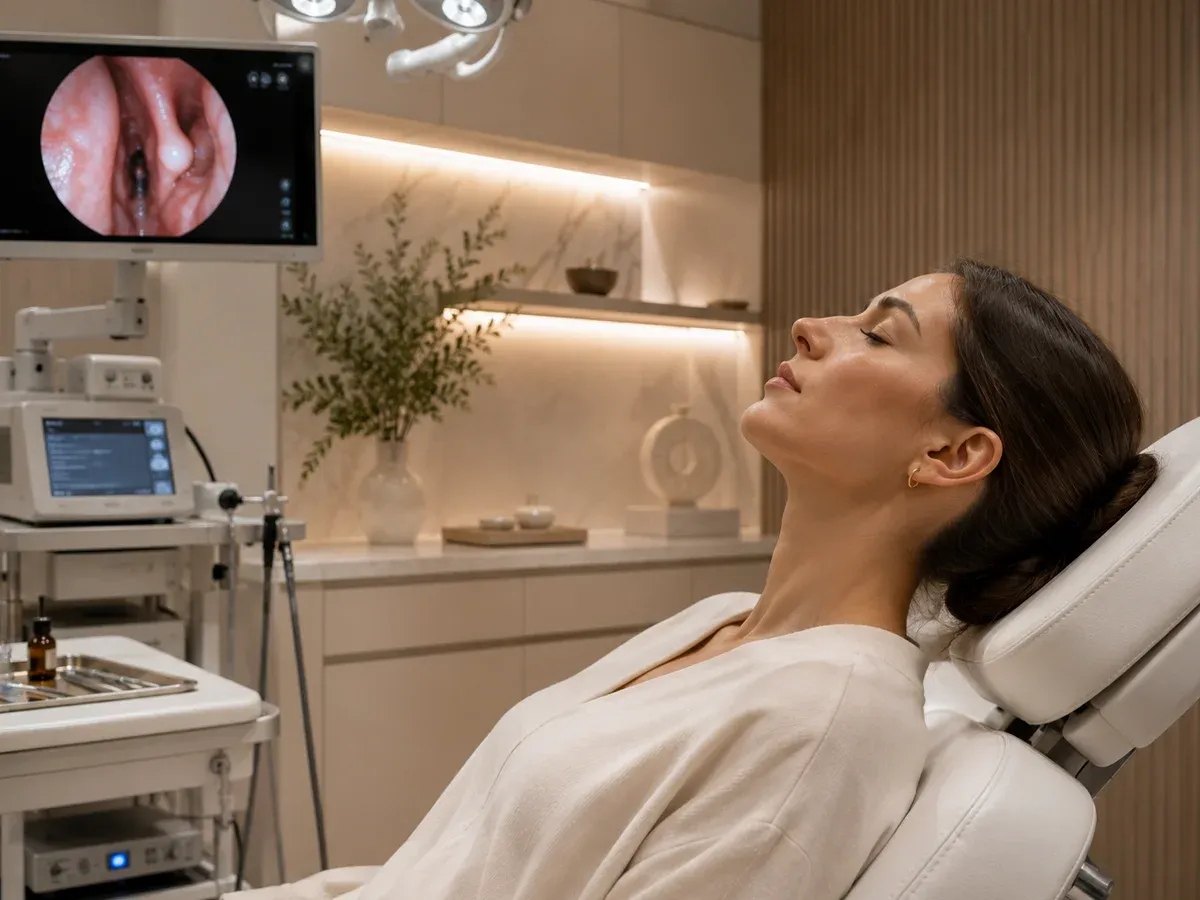
Symptoms alone do not establish the diagnosis. Endoscopic examination identifies where the obstruction actually is, which matters because the septum is only one of several possible causes.
What the operation involves
Septoplasty is usually performed under general anaesthesia and takes around forty-five minutes to an hour on its own.
The mucosal lining is lifted away from the septal cartilage and bone on each side. Deviated segments are then straightened, scored to release their memory, or selectively removed. A critical principle is that the supporting L-strut along the dorsum and the columella is preserved — this is what holds the shape of the nose. Removing too much cartilage weakens the framework and can lead to collapse of the bridge years later.
The lining is replaced and held against the corrected septum with fine absorbable sutures. Soft silicone splints are placed for about a week to keep the layers flat while they heal.
Combining septoplasty with other procedures
The septum is often not the only contributor to obstruction:
- Turbinate reduction. The inferior turbinate on the wider side commonly enlarges over years to fill the space. Correcting the septum without addressing it can leave the patient still blocked.
- Nasal valve support. Where the sidewall collapses on inspiration, spreader grafts widen the internal valve angle. This is a structural correction, not achievable by removing tissue.
- Rhinoplasty. When the outward shape is also a concern, the two operations are combined as a septorhinoplasty under one anaesthetic and one recovery.
Because Dr. Dağlı practises both ENT and facial plastic surgery, the functional and structural elements are planned together rather than referred separately.
Recovery
Expect the nose to feel more blocked, not less, during the first week. This is the swollen lining, not a failure of the operation, and it resolves.
Splints are removed at around seven days, which most patients find a straightforward outpatient appointment. Saline irrigation is started early and continued for several weeks to clear crusting and keep the lining moist. Nose blowing is avoided for the first two weeks, and strenuous exercise for three.
The airway continues to improve over six to eight weeks as the mucosa settles. Most patients return to desk work within a week.
If you want the external shape of your nose changed as well as your breathing improved, see rhinoplasty. Where hearing or ear pressure is also a concern, see ear surgery.